Knife Game Tournament: How Skill Arena’s Knife Mode Runs, Scores, and Wins
Knife Game Tournament: How Skill Arena’s Knife Mode Runs, Scores, and Wins
The knife game tournament in Skill Arena is built for players who want a pure test of timing, precision, and decision-making under pressure. This deep dive explains how Knife Mode works, how scoring really happens, and how the tournament format keeps competition fast, fair, and skill-first.

Skill Arena is a modern skill-based mobile game designed around tight mechanics, short sessions, and real leaderboard competition. Knife Mode emphasizes micro-adjustments, clear timing windows, and a clean action flow—so your rank reflects execution, not luck.
Knife Game Tournament: Mode Overview
Knife Mode is a timing-forward challenge: land a sequence of throws into safe zones on a rotating target while managing rhythm, spacing, and blade collisions. The objective is simple; the mastery comes from consistency across a full run.
Objective
Place every knife without striking an existing blade or a marked danger zone. The target rotates at variable speeds, so you must read motion, commit at the right instant, and keep your streak alive.
Timing and mechanics
- Window control: The target’s rotation and safe zones define a shifting timing window. Early throws may be forgiving; later throws demand sharper precision.
- Rotation reading: Speed ramps and direction changes test your ability to predict travel and settle your release point.
- Collision risk: Each landed blade shrinks your workable arc. Managing space is as important as raw accuracy.
Action flow
Knife Mode delivers fast inputs in clean, readable beats: aim, commit, confirm, and reset focus. That steady action flow rewards players who can lock into a rhythm without rushing timing.
Scoring and streaks
- Base points for every successful stick.
- Streak multipliers for consecutive hits without collision.
- Bonus credit for stick accuracy inside tighter safe zones.
- Efficiency favors clean runs over reckless speed—misses erase multiplier momentum.
Common mistakes to avoid
- Over-aiming as the target accelerates—trust your read and commit.
- Throwing into crowded arcs—rotate your focus to find fresh angles.
- Chasing recovery after a miss—reset your rhythm before the next commit.
Knife Mode vs Memory Mode vs Arcade Toss: Tournament differences
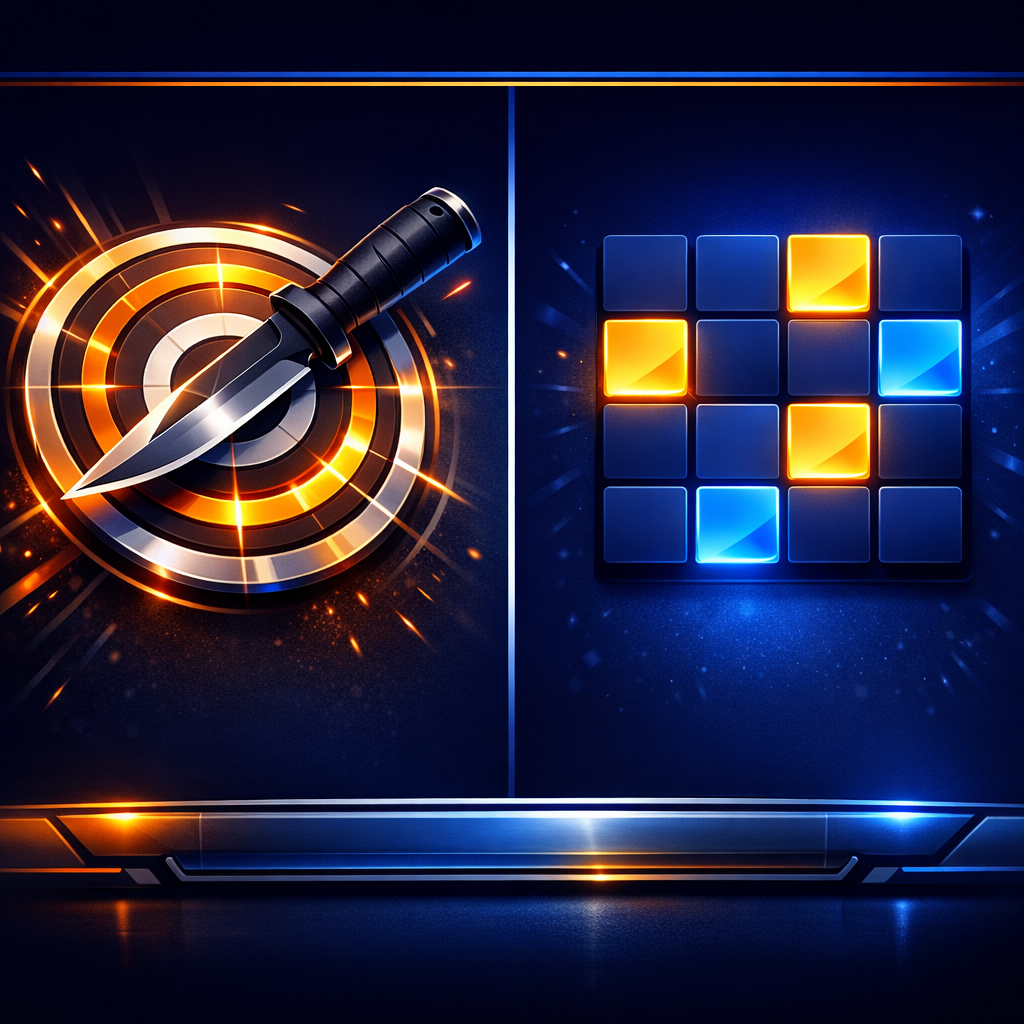
Knife Mode and Memory Mode are both tournament-ready, but they train different skills. Here is a compact comparison to help you choose where to focus practice.
| Mode | Core mechanics | Timing window | Session length | Scoring focus | Best for |
|---|---|---|---|---|---|
| Knife Mode | Precision throws into rotating safe zones | Tight, movement-driven and adaptive | Short, high-intensity | Streaks, collision avoidance, clean hits | Players with great rhythm and spatial reads |
| Memory Mode | Pattern recall and rapid reproduction | Discrete, sequence-defined | Short, structured bursts | Error-free sequences, pace under pressure | Players with strong recall and composure |
| Arcade Toss (typical) | Casual tap-to-throw, loose targets | Wide, often static | Variable | Volume of attempts over precision | Relaxed play, low-pressure sessions |
In Skill Arena, both Knife Mode and the memory game are tuned for competitive parity: standardized runs, synchronized timing rules, and clear scoring logic. If you want a mechanical duel of reflex and rhythm, choose Knife Mode. If you prefer pattern mastery, switch to Memory Mode.
Tournament format: entries, leaderboard, and tie-breaks
Skill Arena tournaments are built around fast, fair sessions. You play standardized runs under the same rules as everyone else in your bracket. Results place you on a live leaderboard, where execution determines rank.
- Standardized runs: Identical target logic and timing rules for all entrants in an event.
- Asynchronous competition: Compete on your schedule within the event window; scores roll up to the same leaderboard.
- Attempts and best score: Events may set a fixed number of entries; your top result counts.
- Tie-breaks: Faster completion, fewer misses, and earlier submission resolve ties cleanly.
Top placements in select events may include gift card rewards tied to leaderboard results. Performance drives outcomes—practice, execute, and move up.
For a broader view of formats and rules, explore the Tournaments Guide and see the platform-level flow in How Skill Arena Works. If you are new to the ecosystem, start with What Is Skill Arena?
Winning technique: practical tips for Knife Mode
- Read, then commit: Track rotation for a full cycle before your first throw to calibrate speed.
- Own your rhythm: Use consistent cadence; avoid panic throws after a close call.
- Protect streaks: A safe hit that preserves multiplier is worth more than a risky perfect.
- Plan space: Visualize your next two placements to avoid painted-into-a-corner arcs.
- Reset after errors: If a miss happens, take a breath and rebuild your streak cleanly.
Want additional competitive context? See our perspective on fair ranking in Leaderboard Games With Prizes: Skill-First.
Fairness and trust: how Skill Arena keeps competition clean
Competitive integrity is non‑negotiable. Knife Mode and Memory Mode share a fairness backbone that keeps outcomes skill-based and consistent.
- Standardized logic per event so everyone faces identical mechanics.
- Server-side validation of runs and timing outcomes.
- Device-parity rules and input sanity checks to stop exploits.
- Anti-tamper and anomaly review for suspicious patterns.
- Transparent scoring so players understand how to improve.
For a platform-wide overview of approach and design principles, visit the Skill-Based Mobile Game Guide.
FAQ
How does scoring work in the knife game tournament?
Each accurate hit adds points, with streaks and clean timing awarding higher multipliers. Misses or blade collisions reset streaks and reduce final efficiency, so consistency matters as much as speed.
What’s the difference between Knife Mode and Memory Mode in Skill Arena?
Knife Mode centers on timing and precision throws, while Memory Mode tests pattern recall and fast reproduction. Both share fair tournament rules, standardized runs, and leaderboard placement.
How are ties resolved on the leaderboard?
Ties are broken by stricter factors such as faster completion time, fewer misses, and earlier run submission, ensuring a clear, fair ranking order without randomness.
Can I win gift cards in Knife Mode tournaments?
Select events award gift card rewards to top finishers. Prizes are performance-based and tied to leaderboard results—practice, precision, and consistency drive outcomes.
Play Knife Mode now
Ready to compete in a format where timing and mechanics decide everything? Download Skill Arena and enter your next tournament today.